
The Economics of the Kingdom…The Earth Is the Lord's

Deuteronomy 8:10-18, Psalm 24:1-2
This week, we begin stewardship season. Over the next three Sundays, we will explore the biblical foundations for God's call to return a portion of what we have to the Lord. We begin today with the Psalms: the earth is the Lord's. Next week, we will consider God's call to till and to keep, given first in the Garden of Eden, to cultivate not only creation, but our God-given talents. And then finally, on Pledge Dedication Sunday, we will explore the scarcity mindset that human fear engenders, juxtaposed with the superabundant generosity of God.
But first, a word about basic economics, which I know many of you understand much better than I do. Much of our modern economics sprang from the philosophical foundation laid down by John Locke. Property ownership arises from mixing labor with nature. These property rights are an extension of personal liberty, and from a governing point of view, this is right. Countries that tend to protect personal property rights also tend to protect human rights.
Property rights incentivize investment, which echoes God's charge to till and to keep. Owners also bear the risk, and so they reap the rewards. And market forces help to allocate resources efficiently, which has led to some of the most prosperous times in history, despite the very real economic inequalities that society needs to confront.
The Bible does not reject this approach to governing. After all, Jesus says, render unto Caesar what is Caesar's, and unto God the things that are God's. But for those of us who follow the way of Jesus, God's word lends a deeper understanding. The question Scripture asks is not "Who holds the bundle of rights?" but "Who holds the world?" The answer is most clearly articulated in the first verse of Psalm 24: "The earth is the Lord's and the fullness thereof." God created all that is, and so it belongs to God. God put us here as stewards, to care for what God has created, and as image bearers, reflecting Christ as we exercise that stewardship.
This is folded into the DNA of our denomination. Our Book of Order tells us that though we hold the title to this building and its assets, we hold them in trust for the mission of God's church in the PC(USA). And what is true of this church is true of each and every one of us, not only of our property and what we own, but of our very lives.
According to some estimates, there are over 2,300 verses about money, wealth, and possessions. It is also estimated that Jesus spoke about finances for roughly 15% of his recorded words, and that money comes up in as many as 16 of his parables. So clearly, Scripture treats this topic as important, because how we use the power of wealth discloses the spiritual core within all of us.
First, we note in Ecclesiastes 5:19 that "when God gives someone wealth and possessions and the ability to enjoy them, to accept their lot and be happy in their toil, this is a gift from God."
Our wealth is a blessing.
It can take us to the Met Opera, to the Great Wall of China, or to an exquisite meal. And it can be used to help lift someone out of hunger, isolation, and sickness.
But as with anything that God gives us, it can also be misused. Deuteronomy 8:17 names the danger, the false story we tell ourselves: "My power and the might of my hand have gotten me this wealth." This is the great irony that the Israelites experienced and everyone after them. The scarcity of the wilderness produced dependence. Israel needed God for manna every day. But prosperity produces self-sufficiency. So the greater spiritual danger is not hunger, but success.
It is a prosperity-induced amnesia. We remember God in the hospital and forget God at the closing table. And so verse 18 serves as the corrective: "Remember the Lord your God, for it is the Lord who gives you the ability to produce wealth, and so to confirm the covenant which God swore to your ancestors, as he is doing today."
And this sin of pride and self-sufficiency carries another danger. The people that God ordains to carry out the covenant mission on earth have often been some of the most affluent of their time. Think of Abraham and Sarah, Jacob and Joseph. It is tempting to conclude that wealth corresponds to righteousness. There are verses throughout the Old Testament that support this idea, such as, "The reward for humility and fear of the Lord is riches and honor and life" (Proverbs 22:4). But there is a counterpoint to this in Ecclesiastes 5:10: "Whoever loves money will not be satisfied with money, nor he who loves wealth with his income; this also is vanity."
In other words, wealth is not one thing. It is a blessing when we treat it as a gift from God, and it becomes a spiritual burden when it breeds false pride.
This is why Jesus tells us it's easier for a camel to go through the eye of a needle than for a rich man to enter the kingdom of God. Jesus was using humor. The outrageous picture underscores the spiritual danger of self-sufficiency.
Thus, the Bible makes it clear: God gives power to get wealth. The life I was born into, the brain I have, the time in history I came into being: none of this was my doing. Behind every "I earned it" stands a God who first gave it. But the Bible doesn't say it's handed to us. It says God gives the power, but we still have to do something. And again, Abraham serves as an example.
He worked the land and he worked the plan, and he became prosperous for it. But God did not give this to Abraham simply for his own benefit. God had a purpose: to grow Abraham's descendants into a people, to teach humanity God's laws through them, and ultimately, through one descendant, to reconcile all of humanity to himself. And part of this plan was a measure of prosperity for Abraham. His wealth was not a trophy of his righteousness. It was equipment for his calling. As God told Abraham, he was blessed to be a blessing. In other words, economic productivity is derivative grace. It is not a blessing on its own, but it is a blessing when it moves towards God's plan of salvation history.
This changes the question we ask about our money. The world asks, "How much do I have?" The steward asks, "What is this for?"
Wealth, then, is a tool God uses to fulfill the two great commandments: to love God and to love your neighbor as yourself.
We see this throughout Scripture. Consider the year of Jubilee. Every 50 years, land was to be returned and debts forgiven, so that economic burdens would not pass from generation to generation. Whether it ever happened is debated, but the principle stands. And in the early church, Acts tells us they had all things in common, so that nobody was in need. This seems to have lasted only a short while, so it is more aspirational than instructional.
But Jesus also challenges us to use our wealth to love our neighbor. In the Sermon on the Mount, he tells us to give to all who ask. In the parable of the laborers in the vineyard, though the workers labored different hours, the owner paid them all the same. When they complained, he answered, "Am I not allowed to do what I choose with what belongs to me? Or are you envious because I am generous?" I don't imagine any of your businesses would last very long if you used that principle.
But it is descriptive of God's extravagant grace. No matter what phase of life we are in, God is always ready to be generous with forgiveness and grace and love.
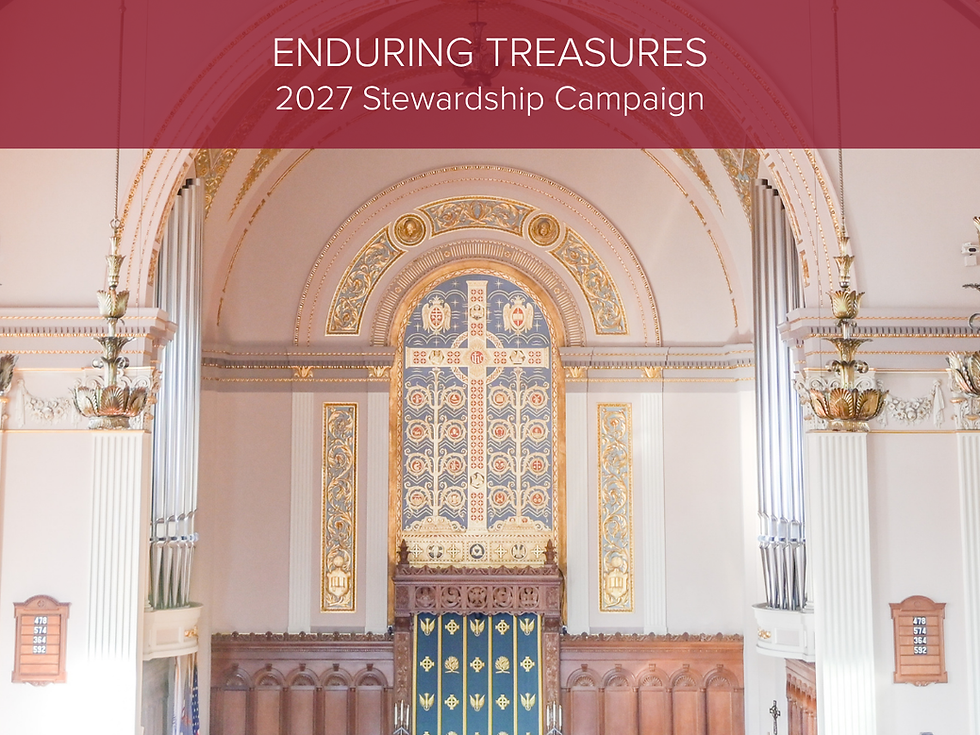
The early church relied on benefactors like Lydia: first, to support the apostles as they traveled, and also for their houses of worship. The first churches were literally the homes of wealthy converts, which over time became sanctuaries like this one. The architectural development is surprisingly clear.
Jesus condemns not wealth itself, but failing to use it for his purposes. That is the tragedy of his parable of the Rich Man and Lazarus.
A rich man lived in luxury every day while a beggar named Lazarus lay at his gate, longing for scraps from his table. Both died. Lazarus was carried to Abraham's side, and the rich man found himself in Hades, looking up at them far off. In all his years of luxury, the rich man never truly saw the man lying at his own gate.
In the Sermon on the Mount, Jesus tells us, do not lay up for yourselves earthly treasures where moth and rust can destroy, but lay up for yourselves treasures in heaven. And he concludes, "For where your treasure is, there will your heart be also."
And that is our stewardship theme this year: "Heavenly Treasures."
Some things to remember. First, the earth is the Lord's, and all that is therein. Our generous God created this theater of life and existence so that we might use it to exalt the divine majesty, and relish the gift of life. We live in a world of deeds and titles, and we are grateful for the order they bring. But beneath every deed in this city, beneath every brokerage statement and every lease, there is an older title that no court can overturn.
Next, it is God who gives us power to get wealth. And it is meant as a blessing.
Third, all this generosity from God comes with a responsibility, as with Abraham and Sarah, that we are blessed to be a blessing.
As we rightly enjoy the blessings of our lives, may we also store heavenly treasures through a generous spirit that uses all that we are to love God without hesitation and to love our neighbor as Christ first loved us. Amen.


Comments